Introduction
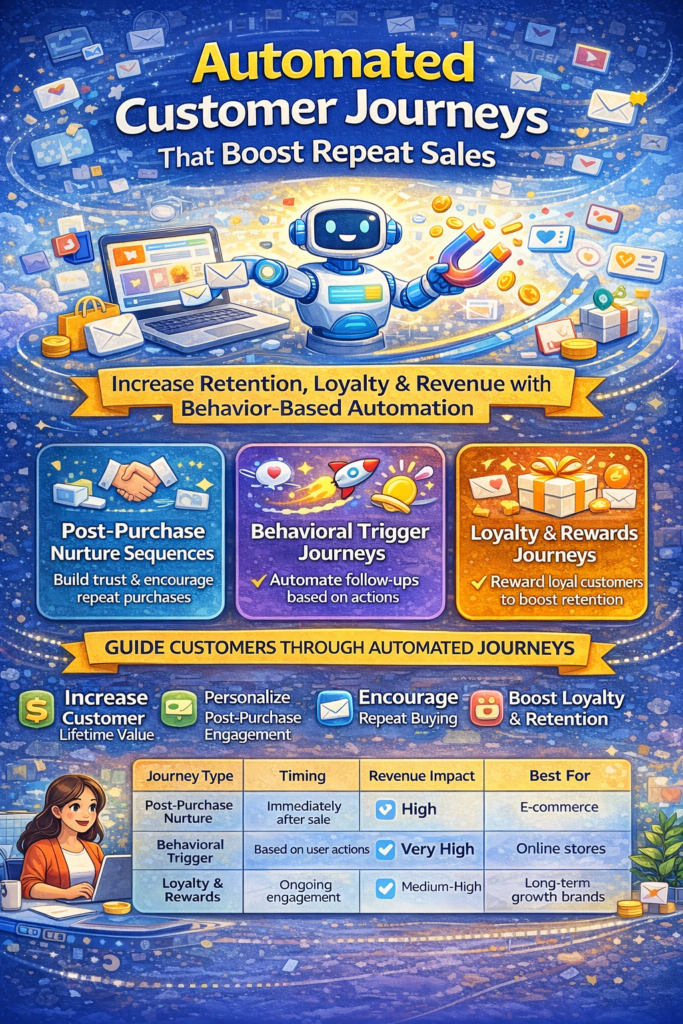
- Customer acquisition is important — but repeat sales drive real business growth. In 2026, brands that rely only on one-time purchases struggle to maintain profitability. Automated customer journeys have become the key to increasing retention, loyalty, and lifetime value.
- With smarter automation tools, behavioral triggers, and AI-powered personalization, businesses can now guide customers through structured post-purchase experiences that encourage repeat buying.
- This blog explores how automated customer journeys work in 2026, the most effective automation strategies, and how businesses can use them to increase retention, repeat purchases, and long-term revenue.
📈 Customer Journey Automation — The Backbone of Repeat Revenue
Modern marketing is no longer campaign-based — it is journey-based.
Automated customer journeys:
- Nurture customers after their first purchase
- Increase engagement through personalized follow-ups
- Encourage upsells and cross-sells
- Strengthen brand loyalty
- Improve customer lifetime value (CLV)
As competition increases and acquisition costs rise, automation focused on retention is no longer optional — it is essential.
🎓 Skills & Mindset for Winning with Customer Journey Automation
Success in automation begins with understanding customer behavior.
- Focus on long-term value, not one-time sales
- Map customer touchpoints clearly
- Use data to personalize each stage
- Optimize based on engagement signals
Brands that align automation with customer psychology build stronger relationships and sustainable revenue growth.
Emerging Automated Journey Strategies Driving Repeat Sales in 2026
📊 1. Post-Purchase Nurture Sequences — Building Immediate Trust
The first 7–14 days after purchase are critical.
- Thank-you and confirmation emails
- Product usage guides or tutorials
- FAQs and support resources
- Personalized recommendations
Benefit: Reduces buyer’s remorse and increases the chance of a second purchase
SEO Keywords: post-purchase automation, customer nurture sequence
🤖 2. Behavioral Trigger Journeys — Action-Based Follow-Ups
Automation triggered by customer actions increases relevance.
- Repeat visit reminders
- Refill or replenishment emails
- Cart abandonment recovery
- Product restock alerts
Benefit: Converts engagement into repeat transactions
SEO Keywords: behavioral automation, triggered email marketing
⚡ 3. Loyalty & Reward Journeys — Encouraging Repeat Engagement
Reward-based automation strengthens retention.
- Points accumulation reminders
- VIP early-access campaigns
- Exclusive discount emails
- Anniversary or birthday offers
Benefit: Builds emotional connection and repeat buying behavior
SEO Keywords: loyalty email strategy, retention marketing automation
The Reality Check — Challenges Brands Face in Automation
💰 1. Poor Journey Mapping
- No clear customer stages
- Random automation triggers
- Overlapping campaigns
Without structured planning, automation becomes confusing and ineffective.
💸 2. Over-Automation Without Personalization
- Generic follow-ups
- Too many emails in short time
- Irrelevant recommendations
Automation must feel helpful — not robotic.
🧘 3. Ignoring Customer Feedback & Data
- Not tracking repeat purchase rate
- Failing to optimize sequences
- No A/B testing
Without performance analysis, journeys fail to improve over time.
🗣️ Voices from Marketers — Lessons from Real Experiences
✨ What Helps Them Succeed
- Mapping the full customer lifecycle
- Using behavior-based triggers
- Combining email, SMS, and retargeting ads
- Monitoring repeat purchase metrics
⚠️ What Holds Them Back
- Focusing only on new leads
- Sending promotional emails too frequently
- Ignoring inactive customers
💡 Marketer Tip: Retention-focused automation generates higher ROI than constant acquisition campaigns.
💻 Interactive Elements — Engage Your Readers
🔁 Quiz: Is Your Customer Journey Optimized for Repeat Sales?
Ask yourself:
- Do you have a structured post-purchase sequence?
- Are your follow-ups personalized based on behavior?
- Do you track repeat purchase rates?
- Is your loyalty system automated?
If not, your customer journey needs optimization.
📍 Interactive Table: Automated Journey Comparison
Post-Purchase Nurture | Immediately after sale | High | E-commerce & SaaS |
Behavioral Trigger | Based on user actions | Very High | Online stores & subscriptions |
Loyalty & Rewards | Ongoing engagement | Medium-High | Retention-focused brands |
✔ Actionable Checklist — Automation That Boosts Repeat Sales
✅ Map your complete customer lifecycle
✅ Set up post-purchase nurture automation
✅ Implement behavioral triggers
✅ Personalize follow-ups with data
✅ Create loyalty-based reward campaigns
✅ Track repeat purchase rate & lifetime value
📌 Conclusion
Automated customer journeys in 2026 are about personalization, timing, and retention-focused strategy. Brands that guide customers beyond the first purchase — through structured nurture, behavior-based triggers, and loyalty systems — will see consistent repeat revenue growth.
When automation aligns with customer experience, repeat sales become predictable rather than accidental.
❓ Most Frequently Asked Questions (SEO-Friendly)
FAQ 1: What is an automated customer journey?
An automated customer journey is a structured sequence of personalized messages triggered by customer actions and lifecycle stages.
FAQ 2: How do automated journeys increase repeat sales?
They maintain engagement after purchase, provide value, and encourage additional buying through timely and relevant communication.
FAQ 3: What is the most important stage in a customer journey?
The post-purchase stage is critical because it influences retention and future buying decisions.
FAQ 4: Are automated journeys expensive to set up?
Not necessarily. Many email marketing platforms offer built-in automation features.
FAQ 5: How can businesses measure success?
Track repeat purchase rate, customer lifetime value, and retention metrics.
Performance Marketing for Study Abroad Consultants: Paid Ads That Actually Convert in 2026
Introduction Student recruitment has become increasingly competitive in 2026, and traditional marketing methods alone are no longer sufficient to attract serious applicants. Students exploring international
Content Marketing Strategy for Study Abroad Consultants in 2026: Blogs, Videos & Webinars
Introduction Student recruitment in 2026 is driven by information, trust, and consistent digital engagement. Students researching overseas education no longer rely on advertisements alone. Instead,
Social Media Funnel Strategy for Study Abroad Consultants: From Reels to Enrollments
Introduction Student recruitment has rapidly shifted toward social media platforms where students spend most of their time discovering opportunities and gathering information. In 2026, platforms
Local SEO Strategies for Study Abroad Consultants to Dominate Google in 2026
Introduction Student recruitment has become increasingly digital, but location still plays a major role in how students search for study abroad consultants. In 2026, students
AI-Powered Lead Generation Strategies for Study Abroad Consultants (2026 Guide)
Introduction Student recruitment has evolved rapidly in the digital era. In 2026, study abroad consultants can no longer rely on traditional advertising, cold outreach, or
End-to-End AI Marketing Ecosystem for Study Abroad Agencies in 2026
Introduction Student recruitment for overseas education has become increasingly competitive in the digital age. In 2026, relying on isolated marketing tactics such as individual ad